

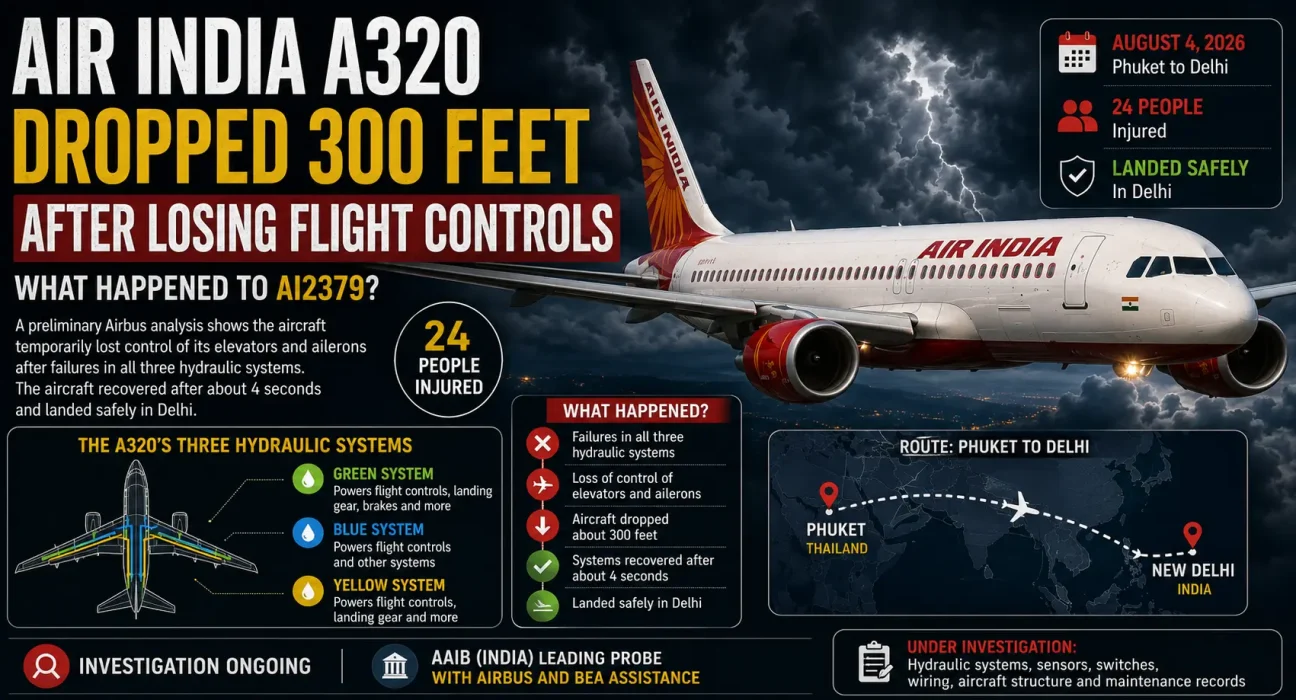
Air India flight AI2379, an Airbus A320 flying from Phuket to Delhi, briefly lost control of key flight surfaces before dropping around 300 feet in altitude on August 4, 2026. A preliminary Airbus analysis now indicates that all three hydraulic systems were affected, causing the aircraft to temporarily lose control of its elevators and ailerons. The aircraft recovered and landed safely in Delhi, but 24 people were injured. Investigators are still working to determine why the unusual failure occurred.
The Air India A320 incident has taken a dramatic turn.
What was initially described by the airline as a turbulence-related event is now being investigated as a serious aviation incident involving the aircraft’s flight-control systems.
The most significant new finding comes from Airbus.
According to a preliminary Airbus analysis of the aircraft’s data, the A320 temporarily lost control of its elevators and ailerons for approximately four seconds after failures involving all three hydraulic systems. The aircraft then regained control. Airbus has requested additional testing and inspection of the aircraft, including its hydraulic systems, sensors, switches, wiring and structural components.
But there is an important distinction:
Airbus has identified what happened to the aircraft’s systems. It has not yet established the final cause of why it happened.
That is why the AI2379 investigation is important.
Air India AI2379 incident: What happened?
Air India flight AI2379 was operating from Phuket, Thailand, to New Delhi on August 4, 2026.
During the flight, the aircraft experienced a sudden loss of altitude of approximately 300 feet.
The event injured passengers and crew members. The latest reporting puts the number of injured at 24. The aircraft subsequently stabilised and landed safely in Delhi.
The aircraft involved was an Airbus A320.
The incident initially attracted attention because passengers experienced a sudden and unexpected movement of the aircraft. But subsequent technical analysis has made the story much more significant.
According to Airbus’s preliminary assessment, the aircraft temporarily lost the ability to control two important flight surfaces:
- Elevators, which control pitch — the aircraft’s nose moving up or down.
- Ailerons, which control roll — the aircraft banking left or right.
The loss of control lasted roughly four seconds before the systems recovered.
The short answer
If you’re looking for the simplest explanation of the Air India A320 incident:
AI2379 experienced a temporary flight-control problem associated with simultaneous failures of its three hydraulic systems. The aircraft lost control of its elevators and ailerons for about four seconds, dropped around 300 feet, then recovered. The exact root cause remains under investigation.
That last sentence is particularly important.
The investigation is not finished.
Why did the Air India A320 drop 300 feet?
The aircraft’s loss of altitude is believed to be connected to the temporary loss of control of its flight surfaces.
To understand why, it helps to understand what those surfaces do.
An aircraft in cruise needs continuous control over three basic movements:
Pitch
Pitch controls whether the aircraft’s nose points upward or downward.
The elevators are important for controlling pitch.
Roll
Roll is the aircraft’s banking movement.
The ailerons control roll.
Yaw
Yaw is the movement of the aircraft’s nose from side to side.
The rudder is primarily responsible for yaw control.
During the AI2379 event, Airbus’s preliminary analysis found that the aircraft temporarily lost control of the elevators and ailerons. That means two important dimensions of aircraft movement were affected simultaneously.
The result was a rapid change in the aircraft’s flight path and an altitude loss of around 300 feet.
For passengers, that can feel like the aircraft suddenly dropping.
But technically, saying that the plane “fell 300 feet” is an oversimplification.
The aircraft remained an aircraft under controlled flight conditions, and its systems recovered sufficiently for the crew to stabilise the flight and land safely.
What does “loss of flight controls” mean on an Airbus A320?
The phrase “loss of flight controls” sounds catastrophic because most passengers understandably interpret it as meaning the pilots could no longer fly the aircraft.
The reality is more complicated.
The Airbus A320 uses a fly-by-wire flight-control system.
In a traditional aircraft, moving the pilot’s controls could be connected mechanically to the aircraft’s control surfaces.
On the A320, pilot commands are interpreted electronically by flight-control computers.
The computers then send commands to the systems responsible for moving the aircraft’s control surfaces.
This allows the aircraft to continuously monitor flight conditions and manage control inputs.
The system is also designed with redundancy.
That redundancy is one of the reasons the A320 can continue flying when individual components or systems fail.
So when we say the AI2379 aircraft experienced a temporary loss of flight controls, we should not automatically interpret that as “the pilots had no control over the airplane for the entire flight.”
The preliminary finding is much more specific:
The aircraft temporarily lost control of key flight surfaces during the incident.
The systems subsequently recovered.
Why are the A320’s three hydraulic systems important?
This is probably the most important technical part of the Air India A320 incident.
The Airbus A320 has three separate hydraulic systems commonly identified as:
- Green
- Blue
- Yellow
Hydraulic systems provide the force required to operate various aircraft systems, including important flight-control functions.
The reason an aircraft has multiple hydraulic systems is redundancy.
In aviation, redundancy means that one failure should not automatically become a catastrophic failure.
If one system becomes unavailable, other systems can continue supporting aircraft functions.
The A320 hydraulic architecture also incorporates additional backup mechanisms.
One example is the Power Transfer Unit (PTU), which can transfer hydraulic power between certain systems when pressure conditions require it.
The A320 also has emergency power arrangements, including the Ram Air Turbine (RAT), which can provide emergency power when necessary.
This is why the latest Airbus finding is so significant.
It is not simply:
“One hydraulic system failed.”
The preliminary analysis indicates that all three hydraulic systems were affected during the event.
That is an unusual situation for an aircraft designed with multiple independent layers of redundancy.
Did all three hydraulic systems fail at the same time?
According to the preliminary Airbus analysis reported today, the aircraft experienced failures involving all three hydraulic systems within a very short period, and the systems subsequently recovered.
This is one of the central questions investigators now have to answer.
Why?
Because three hydraulic systems exist partly to prevent a single technical failure from causing a loss of critical aircraft control.
Therefore, investigators need to determine whether:
- three genuinely independent failures occurred;
- a common underlying problem affected all three systems;
- an electrical or control-system issue generated the observed failure;
- sensors or switches provided incorrect information;
- wiring or another component affected multiple systems;
- maintenance or component condition played a role;
- or another mechanism caused the simultaneous loss of hydraulic capability.
At this stage, there is no confirmed final explanation.
That is why headlines suggesting that investigators have already identified the precise cause should be treated cautiously.
How did the Air India A320 recover?
The aircraft recovered its flight-control capability after the temporary failure.
The Airbus preliminary analysis indicates that the loss of control lasted approximately four seconds, after which the relevant systems recovered.
The aircraft eventually landed safely in Delhi.
This is an important part of the story.
A serious technical malfunction does not necessarily mean that an aircraft is going to crash.
Modern commercial aircraft are designed around multiple layers of protection, monitoring and redundancy.
Pilots are also trained to manage abnormal situations and follow aircraft procedures.
However, it would be wrong to conclude that because the aircraft recovered, the event was insignificant.
The fact that the aircraft temporarily lost control of key flight surfaces is precisely why investigators are examining it so closely.
What are investigators examining now?
The Aircraft Accident Investigation Bureau, or AAIB, is investigating the incident, with technical assistance from Airbus and France’s Bureau of Enquiry and Analysis for Civil Aviation Safety, known as BEA.
The investigation is expected to use several sources of evidence.
1. Flight Data Recorder
The Flight Data Recorder can show what happened to the aircraft’s systems and flight parameters during the event.
Investigators can reconstruct changes in altitude, speed, attitude, flight-control behaviour and system status.
2. Cockpit Voice Recorder
The Cockpit Voice Recorder provides information about what happened inside the cockpit.
It can help investigators understand the crew’s actions, communications, warnings and response to the event.
3. Hydraulic systems
Investigators will inspect the three hydraulic systems for evidence of:
- pressure loss;
- mechanical failure;
- leakage;
- component damage;
- abnormal system behaviour.
4. Sensors and switches
Sensors are essential to modern aircraft because computers need accurate information about system conditions.
Investigators therefore need to determine whether the aircraft received correct information during the event.
5. Electrical wiring
Because the A320 uses digital fly-by-wire controls, electrical systems and wiring are also important parts of the investigation.
Airbus has specifically requested further inspection of wiring, sensors and switches.
6. Aircraft structure
Airbus has also requested checks of the aircraft’s structural integrity because of the forces experienced during the event.
7. Maintenance records
Investigators will also need to examine the aircraft’s maintenance history and technical records.
This can help establish whether any component had previously shown abnormal behaviour or whether maintenance work could have influenced the event.
Was the Air India A320 incident caused by turbulence?
The incident was initially described by Air India as turbulence-related.
However, the latest Airbus analysis has shifted the focus toward the aircraft’s flight-control and hydraulic systems. Reuters reports that Indian authorities are now treating the event as a serious incident rather than simply an ordinary turbulence event.
That does not necessarily mean turbulence played no role.
It means investigators now have additional technical information that must be considered.
The distinction matters because turbulence and a technical malfunction can produce similar passenger experiences: sudden aircraft movement, altitude changes and injuries inside the cabin.
The investigation must determine the exact sequence.
Did the pilot’s drug test cause the incident?
This is one of the most searched and discussed questions surrounding AI2379.
The captain reportedly tested positive for marijuana in a confirmatory test following the incident. The development prompted additional scrutiny of the crew and led Air India to introduce broader substance testing for its pilots.
However, there is currently no established evidence that the test result caused the aircraft’s technical malfunction.
This distinction is essential.
A positive test result is a separate investigative issue from the preliminary Airbus finding concerning the hydraulic systems.
Investigators may examine both technical and human factors, but one should not automatically be presented as proof of the other.
Until investigators establish a causal connection, claims that the pilot’s test explains the 300-foot altitude loss remain speculation.
Does the Air India incident mean Airbus A320 aircraft are unsafe?
No conclusion that the entire A320 fleet is unsafe has been established from this incident.
The A320 is one of the world’s most widely operated commercial aircraft families.
The purpose of an aviation investigation is precisely to determine whether a failure was:
- isolated to one aircraft;
- related to a particular component;
- caused by maintenance;
- related to operating conditions;
- or indicative of a wider technical issue.
If investigators discover a fleet-wide problem, regulators can require inspections, modifications or other corrective measures.
If the problem is isolated, the corrective action may be limited to the aircraft or specific components involved.
That is why it is too early to answer the broader question of whether passengers should avoid A320 aircraft.
The investigation needs to establish the root cause first.
What does the Air India AI2379 incident mean for passengers?
For passengers, the incident offers two practical lessons.
First: don’t confuse a serious incident with a confirmed aircraft-wide safety problem.
The A320 involved in AI2379 experienced an unusual technical event.
That does not automatically mean every A320 is at similar risk.
Second: keep your seat belt fastened when seated.
The reported injuries demonstrate how dangerous sudden aircraft movements can be for people who are standing or not properly restrained.
Passengers should follow crew instructions and keep their seat belt securely fastened whenever seated, even when the seat-belt sign is not illuminated.
That simple precaution can significantly reduce the risk of injury during unexpected aircraft movement.
Air India A320 incident: What we know and what we don’t
The clearest way to understand the story is to separate confirmed information from unanswered questions.
What we know
- Air India flight AI2379 was flying from Phuket to Delhi.
- The incident occurred on August 4, 2026.
- The aircraft experienced an altitude loss of approximately 300 feet.
- 24 people were injured, according to the latest reporting.
- The aircraft was an Airbus A320.
- Airbus’s preliminary analysis found temporary loss of control of the elevators and ailerons.
- The event was associated with failures involving all three hydraulic systems.
- The loss of flight-control capability lasted approximately four seconds.
- The aircraft recovered and landed safely in Delhi.
- AAIB is investigating the incident.
- Airbus and France’s BEA are assisting.
- Airbus has requested further inspections and testing.
What we don’t know
- The final root cause of the hydraulic-system failures.
- Why all three hydraulic systems were affected.
- Whether the issue originated in a component, wiring, sensors, maintenance or another system.
- Whether other A320 aircraft require additional inspections.
- Whether any human factor contributed to the event.
- What final safety recommendations investigators will make.
Those answers will come from the investigation.
Frequently Asked Questions
What happened to Air India flight AI2379?
Air India flight AI2379, travelling from Phuket to Delhi on August 4, 2026, experienced a sudden altitude loss of approximately 300 feet. A preliminary Airbus analysis found that the aircraft temporarily lost control of its elevators and ailerons following failures involving all three hydraulic systems. The aircraft recovered and landed safely.
Why did the Air India A320 drop 300 feet?
The precise root cause has not yet been established. Airbus’s preliminary analysis indicates that the aircraft temporarily lost control of its elevators and ailerons after failures involving all three hydraulic systems. This temporary loss of flight-control capability was associated with the altitude loss.
What are the three hydraulic systems on an Airbus A320?
The A320 has three hydraulic systems commonly identified as the green, blue and yellow systems. They provide hydraulic power for important aircraft functions, including flight-control operations.
Did the Air India plane lose all flight controls?
The preliminary Airbus analysis indicates that the aircraft temporarily lost control of its elevators and ailerons for approximately four seconds. That does not mean the aircraft permanently lost every form of control or that the pilots were unable to operate the aircraft for the remainder of the flight.
Was Air India AI2379 caused by turbulence?
The incident was initially described as turbulence-related, but subsequent technical findings have shifted attention toward the aircraft’s hydraulic and flight-control systems. The investigation is still determining the exact sequence and cause.
Is the Airbus A320 safe?
There is currently no basis from this single incident to conclude that the entire Airbus A320 fleet is unsafe. Investigators must first determine whether the AI2379 event resulted from an isolated failure or a wider technical issue.
How many people were injured on Air India AI2379?
The latest Reuters reporting says 24 people were injured in the incident.
What is being investigated after the Air India A320 incident?
Investigators are examining flight data, cockpit recordings, hydraulic systems, sensors, switches, wiring, aircraft structure, maintenance records and other evidence to determine the cause of the incident.
The bigger question: why did three hydraulic systems fail?
That is ultimately the question that matters most.
The headline is about a 300-foot drop.
The deeper aviation story is about redundancy.
An Airbus A320 is designed with multiple systems precisely because aviation engineers assume that individual components can fail.
So when an aircraft experiences a temporary loss of control associated with all three hydraulic systems, investigators have to look beyond the immediate symptom.
They need to understand whether there was a common cause capable of affecting multiple supposedly independent systems.
That could have implications for maintenance, engineering, components, software, wiring, sensors or operating procedures.
But at this stage, the evidence does not justify choosing one explanation.
And that is where responsible reporting matters.
The Air India AI2379 incident is serious.
It deserves scrutiny.
But the investigation should be allowed to establish the cause before conclusions are drawn.
Bottom line
The Air India A320 that was flying from Phuket to Delhi did not simply encounter an ordinary 300-foot turbulence drop. According to Airbus’s preliminary analysis, the aircraft temporarily lost control of its elevators and ailerons after failures involving all three hydraulic systems. The flight-control problem lasted about four seconds before the aircraft recovered. Twenty-four people were injured, but the aircraft landed safely. The exact root cause remains under investigation.
For passengers, there is no confirmed evidence from this incident alone that the Airbus A320 is broadly unsafe.
For investigators, however, one question remains critical:
How did three hydraulic systems designed with redundancy become affected during the same event?
The answer to that question — not the speculation surrounding the incident — will determine what happens next for Air India, Airbus and potentially the wider A320 fleet.


