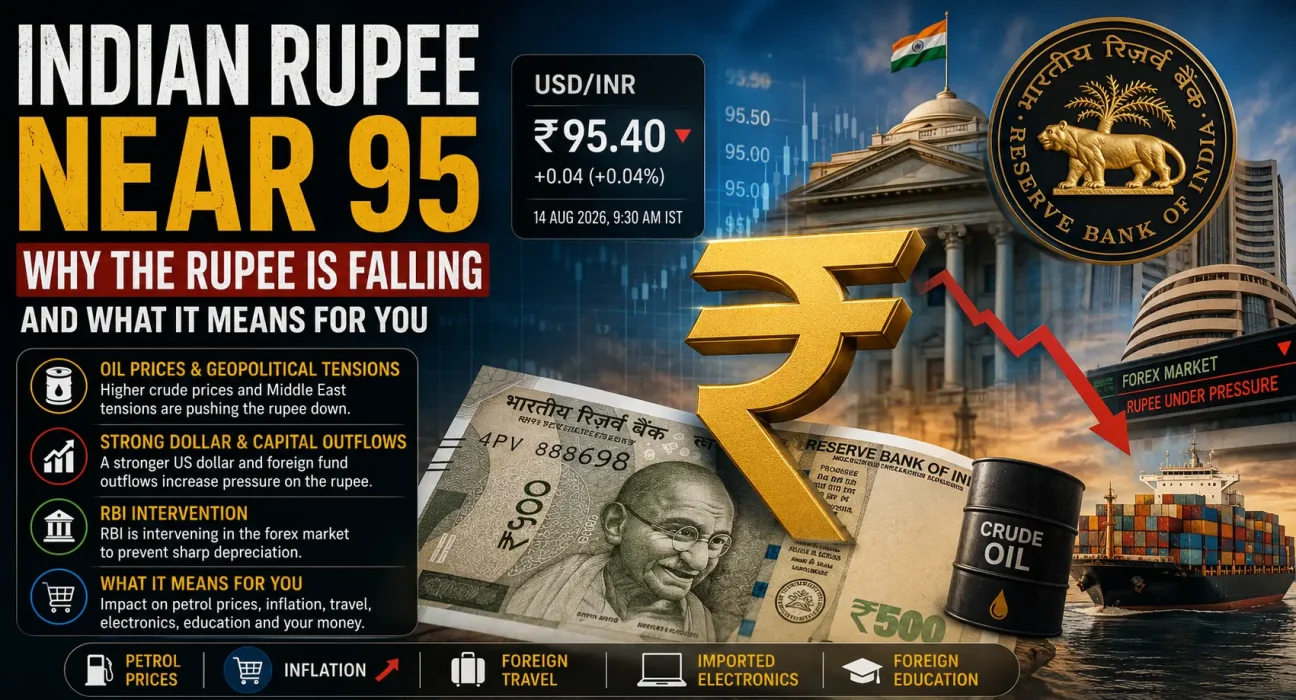
The Indian rupee is near ₹95 per US dollar in August 2026, with oil prices, Middle East tensions, dollar demand and foreign capital flows putting pressure on the currency. The RBI appears to be intervening to limit sharp movements. Here is why the rupee is near 95, how oil affects it, what the RBI can do and what a weaker rupee means for fuel, inflation, travel, electronics, education, investments and the Indian economy.
The Indian rupee near 95 has become more than a number on a currency screen.
For most people, ₹95 against the US dollar may initially look like a financial-market story that matters only to traders, banks and investors.
It isn’t.
The exchange rate between the rupee and dollar can eventually affect the price India pays for crude oil, imported electronics, foreign education, international travel, machinery, medicines and other goods and services.
And right now, the pressure on the rupee is coming at a particularly sensitive time.
On August 14, the rupee was trading around ₹95.38–₹95.43 per US dollar in early trade after closing at ₹95.44 on Thursday. Reuters reported that traders believed the Reserve Bank of India was intervening through the foreign-exchange market to prevent the rupee from weakening beyond the ₹95.50 level.
The bigger question, however, is not simply “Will the rupee cross ₹95?”
It is:
Why is the Indian rupee near 95, and what does that actually mean for ordinary Indians?
Indian rupee near 95: What is happening right now?
The rupee has been under pressure as several factors have come together.
The most important is oil.
India imports roughly 90% of its crude oil requirements, making the country particularly sensitive to changes in international crude prices. Middle East geopolitical tensions have pushed oil prices higher and increased concerns about India’s import bill.
At the same time, importers need dollars to pay for goods purchased overseas.
When oil becomes more expensive, Indian companies need more dollars to purchase roughly the same physical quantity of crude.
That increases demand for dollars.
More dollar demand, all else being equal, puts pressure on the rupee.
There are other forces involved too.
Foreign investors have been moving money out of some Indian assets, while companies and financial institutions have dollar-payment requirements. India’s merchandise trade deficit also widened to $31.98 billion in July, with imports reaching $76.22 billion.
So the rupee is facing pressure from several directions simultaneously.
Why does the rupee fall when the dollar becomes expensive?
The basic mechanism is supply and demand.
Imagine an Indian oil company needs to pay an overseas supplier $1 billion.
The company needs to obtain those dollars.
If the exchange rate is:
$1 = ₹90
the company needs roughly ₹9,000 crore to buy $1 billion.
At:
$1 = ₹95
the same $1 billion costs roughly ₹9,500 crore.
Nothing about the amount of oil purchased necessarily changed.
The cost in rupees changed because the currency exchange rate changed.
Now multiply that effect across India’s enormous import requirements.
That is why the relationship between the rupee and oil is so important.
The basic chain is:
Higher oil prices → larger dollar requirement → greater demand for dollars → pressure on rupee → higher rupee cost of imports
And when geopolitical tensions simultaneously increase demand for safe-haven assets such as the US dollar, emerging-market currencies can face additional pressure.
This is one reason the current rupee story cannot be explained by one factor alone.
Why is oil such a big problem for India?
India is one of the world’s major oil consumers but does not produce enough crude domestically to meet its needs.
That means international crude prices matter enormously to India’s external finances.
When Brent crude rises, Indian refiners and importers generally need more dollars to pay for imports.
Reuters reported that India’s July oil import bill was about $18.31 billion, even though the volume of oil imports was marginally lower. Higher international prices kept the overall bill elevated.
The impact doesn’t stop with the oil company.
Crude oil is an input into a huge part of the economy.
It affects:
- Petrol and diesel
- Aviation fuel
- Transport
- Logistics
- Chemicals
- Plastics
- Fertilisers
- Manufacturing
- Packaging
- Agriculture
- Construction
That creates a second problem.
If the rupee weakens while oil prices rise, India can face a double hit.
Higher oil price
means India pays more in dollars.
Weaker rupee
means every dollar costs more rupees.
Together:
Higher crude + weaker rupee = potentially much higher rupee cost of imported oil.
That is one of the biggest reasons policymakers pay close attention to the currency.
Is the RBI stopping the rupee from falling below 95?
The RBI appears to be actively managing volatility.
Reuters reported on August 14 that three traders believed the central bank had intervened in the foreign-exchange market, with state-owned banks selling dollars on its behalf. The intervention helped keep the rupee around ₹95.40 and prevented it from moving beyond the psychologically important ₹95.50 level.
But there is an important distinction.
The RBI is not necessarily trying to defend one specific number forever.
The central bank’s broader objective is to prevent disorderly movements and excessive volatility in the currency market.
The RBI can use its foreign-exchange reserves and market operations to influence dollar liquidity and reduce sudden pressure.
It cannot permanently eliminate the economic forces pushing the rupee in one direction.
If oil prices remain high, importers continue demanding dollars and foreign capital keeps leaving, the underlying pressure can remain even after central-bank intervention.
That is why intervention should be viewed as a shock absorber, not an unlimited shield.
How does RBI intervention work?
The simplest way to understand RBI intervention is to imagine a market where there are suddenly many buyers of dollars and not enough sellers.
The price of the dollar rises.
The rupee consequently weakens.
The central bank can sell dollars from its foreign-exchange reserves into the market.
That increases the supply of dollars.
Greater dollar supply can reduce immediate pressure on the rupee.
In simplified form:
Dollar demand rises → rupee weakens
Then:
RBI sells dollars → dollar supply rises → pressure can ease
This is one reason the rupee has remained in a relatively narrow range despite substantial geopolitical uncertainty.
Reuters reported that the rupee traded within roughly a 30-paisa range recently, while implied volatility fell to its lowest level since March, reflecting expectations of continued RBI support.
But intervention has limits.
Foreign-exchange reserves are valuable precisely because they provide protection against external shocks.
The central bank therefore has to balance market stability with the need to maintain adequate reserves.
What happens if the rupee becomes weaker?
A weaker rupee does not affect everyone in exactly the same way.
Some people and businesses lose.
Others can benefit.
The key question is whether you are buying dollars or earning dollars.
If you need dollars, a weaker rupee generally hurts.
If you earn dollars and convert them into rupees, a weaker rupee can help.
That distinction explains why exporters and importers can have completely different opinions about the same exchange-rate movement.
What does a ₹95 dollar mean for petrol and diesel?
This is where things become more complicated.
A weaker rupee increases the rupee cost of imported crude oil.
But it does not automatically mean petrol and diesel prices will increase by exactly the same percentage.
Retail fuel prices depend on several factors, including:
- International crude prices
- Refining costs
- Taxes
- Marketing margins
- Exchange rates
- Domestic pricing decisions
- Government policy
Therefore, it would be incorrect to say:
“Rupee reaches ₹95, so petrol will immediately become ₹X more expensive.”
The actual pass-through can take time and can be partial.
But a persistently weak rupee combined with high crude prices increases the underlying cost pressure.
That is the important economic relationship.
Will a weaker rupee increase inflation in India?
Potentially, yes.
A weaker currency makes imported goods and imported inputs more expensive in rupee terms.
That can create imported inflation.
Oil is particularly important because it affects transportation and production costs across the economy.
India’s retail inflation increased to 4.45% in July 2026, up from 4.38% in June, according to Reuters’ report on the latest government data.
At the wholesale level, July inflation was 9.78% year-on-year, although it eased slightly from June’s 9.87%, with energy inflation contributing to the moderation.
This means the currency story is arriving at a time when inflation deserves attention.
However, the rupee alone does not determine India’s inflation rate.
Food prices, domestic demand, global commodity prices, supply conditions and government policies also matter.
What happens to imported electronics?
This is one of the easiest ways ordinary consumers can eventually feel currency depreciation.
Consider a product whose imported component costs $500.
At ₹90/$:
$500 = ₹45,000
At ₹95/$:
$500 = ₹47,500
That is a ₹2,500 difference before considering taxes, margins, shipping and other costs.
The actual retail-price impact may therefore be smaller or larger depending on the product and the company’s pricing strategy.
India’s electronics import bill is already significant.
The country’s merchandise imports rose sharply in July, with electronics imports up 44% year-on-year, according to Reuters.
That makes the exchange rate particularly relevant for electronics manufacturers and consumers.
Products with substantial imported components can become more expensive when the rupee weakens.
What does a weak rupee mean for foreign travel?
For Indians travelling abroad, the mathematics is simple.
Suppose your overseas trip requires:
$2,000
At ₹90/$:
₹1,80,000
At ₹95/$:
₹1,90,000
That’s ₹10,000 more simply because of the exchange rate.
The actual cost will vary depending on hotel prices, airfare, card fees, taxes and other expenses.
But the basic principle remains:
A weaker rupee means Indians need more rupees to buy the same number of dollars.
That can affect travel to the United States and countries where expenses are effectively dollar-linked.
It can also affect international payments made through cards and other financial channels.
What about students studying abroad?
Foreign education is another area where the rupee-dollar exchange rate matters significantly.
Tuition fees at US universities are generally denominated in dollars.
Suppose annual tuition is:
$40,000
At ₹90/$:
₹36 lakh
At ₹95/$:
₹38 lakh
That’s a difference of ₹2 lakh before considering living expenses.
For families funding education from India, a weaker rupee can therefore materially increase the rupee value of the same dollar-denominated bill.
This is why students and parents often monitor currency movements months before tuition payments are due.
Does a weaker rupee hurt Indian companies?
Not all companies.
The effect depends heavily on a company’s business model.
Import-heavy companies
Companies that purchase significant amounts of goods, raw materials or energy from abroad can face higher costs.
Examples can include businesses exposed to:
- Crude oil
- Electronics components
- Industrial machinery
- Chemicals
- Certain pharmaceutical inputs
- Imported metals
Export-oriented companies
Companies that earn significant revenue in dollars can benefit when those dollars are converted into more rupees.
For example, if an Indian exporter earns:
$10 million
then:
At ₹90/$ → ₹90 crore
At ₹95/$ → ₹95 crore
Again, the real benefit depends on the company’s costs, hedging arrangements and foreign-currency exposure.
So a weaker rupee is not automatically bad for every Indian company.
Why India’s trade deficit matters for the rupee
Another important part of today’s story is India’s trade deficit.
India recorded a merchandise trade deficit of $31.98 billion in July 2026, a six-month high. Imports rose to $76.22 billion, while merchandise exports reached a record $44.24 billion.
This creates an interesting picture.
India’s exports are performing strongly.
But imports are also very large.
When a country imports more goods than it exports, there is greater demand for foreign currency to pay for those imports.
That can create pressure on the domestic currency, although the overall external balance also includes services, remittances and other capital flows.
India’s services sector is important here.
A merchandise trade deficit by itself does not tell the complete story about the country’s external position.
That is why analysts look beyond one monthly number.
Is ₹95 per dollar a crisis for India?
No. A rupee-dollar rate near ₹95 does not by itself mean India is facing a currency crisis.
This distinction is important.
Currency levels need to be interpreted alongside:
- Foreign-exchange reserves
- Inflation
- Current-account position
- Trade deficit
- Capital flows
- Oil prices
- Interest-rate differentials
- Economic growth
- External debt
The RBI has tools to manage market liquidity and excessive volatility.
The bigger risk would be a combination of persistent oil shocks, prolonged geopolitical disruption, sustained capital outflows and continued currency depreciation.
One isolated exchange-rate level does not establish an economic crisis.
Could the rupee become stronger again?
Yes.
Currencies move in both directions.
If geopolitical tensions ease, oil prices fall, foreign capital returns to Indian markets and dollar demand decreases, pressure on the rupee could reduce.
A stronger dollar globally can also weaken the rupee, while a softer dollar can provide relief.
This is why predicting a precise rupee level weeks or months in advance is unreliable.
The more useful question is:
What forces are currently driving USD/INR?
Right now, the important factors include oil, geopolitical risk, dollar demand, foreign flows, India’s trade balance and RBI intervention.
What should Indians watch next?
There are five indicators worth watching.
1. Crude oil prices
This is probably the most immediate external variable.
If oil remains elevated, pressure on India’s import bill can persist.
2. RBI intervention
The market will watch how aggressively the central bank responds to sharp currency movements.
3. Foreign investment flows
Large foreign outflows can increase demand for dollars and put additional pressure on the rupee.
4. India’s trade data
A widening trade deficit can increase concern about the country’s demand for foreign currency.
5. Inflation
If currency weakness and higher commodity prices feed into domestic inflation, monetary-policy expectations can change.
These factors are interconnected.
Indian rupee near 95: What it means for you
The easiest way to understand the current situation is to forget the financial jargon.
If you buy something priced in dollars, a weaker rupee generally makes it more expensive.
If you travel or study abroad, you need more rupees for the same dollar expense.
If you import goods or raw materials, your costs can rise.
If you earn dollars, a weaker rupee can increase your rupee income.
If you own Indian companies dependent on imports, currency weakness can pressure margins.
If you own export-oriented businesses, the impact can be more favourable.
And if oil prices remain high at the same time, the pressure can spread through transportation, manufacturing and inflation.
So the ₹95 number is not important because it is a magical threshold.
It is important because it reflects a broader economic story.
Frequently Asked Questions
Why is the Indian rupee near 95 against the dollar?
The rupee is under pressure from elevated oil prices, Middle East geopolitical tensions, dollar demand, foreign capital flows and India’s large import requirements. The RBI appears to be intervening to limit sharp movements in the currency.
What is the Indian rupee exchange rate today?
On August 14, 2026, the rupee opened around ₹95.36–₹95.38 per US dollar in early trading and was reported around ₹95.40–₹95.43 during early market activity. It had closed at ₹95.44 on August 13. Currency rates move continuously during market hours.
Why does crude oil affect the Indian rupee?
India imports a large share of its crude oil. When international oil prices rise, Indian importers generally need more dollars to pay for oil. Higher demand for dollars can put downward pressure on the rupee.
Is RBI trying to stop the rupee at ₹95?
The RBI appears to be intervening to prevent excessive volatility, and traders reported dollar sales by state-owned banks on the central bank’s behalf. That does not mean the RBI has permanently fixed the rupee at ₹95.
Will a ₹95 rupee-dollar rate increase petrol prices?
A weaker rupee can increase the rupee cost of imported crude oil, but petrol and diesel prices depend on several factors, including global crude prices, taxes, refining costs and domestic pricing decisions. Therefore, a ₹95 exchange rate does not automatically produce a specific petrol-price increase.
Will the weak rupee increase inflation?
It can contribute to inflation by making imported goods and inputs more expensive. Oil is particularly important because transportation and production costs can be affected. India’s retail inflation rose to 4.45% in July 2026.
Does a weak rupee benefit exporters?
It can. An Indian company earning dollars may receive more rupees when those dollars are converted. However, the benefit depends on the company’s imported input costs, foreign-currency liabilities, hedging and business model.
Does the rupee at 95 make foreign education more expensive?
Generally, yes. If tuition is denominated in US dollars, Indian families need more rupees to purchase the same amount of dollars when the rupee weakens.
Is ₹95 per dollar a currency crisis?
No. The exchange rate alone does not establish a currency crisis. Analysts also examine foreign-exchange reserves, inflation, capital flows, the current account, external debt, trade and broader economic conditions.
Bottom Line: Why the Rupee Near ₹95 Matters
The Indian rupee near 95 is not simply a currency-market headline.
It is the visible result of several forces colliding at once: high oil prices, geopolitical uncertainty, dollar demand, foreign investment flows and India’s large import requirements.
The RBI can reduce sudden volatility by intervening in the foreign-exchange market, and current trading suggests that its actions have helped keep the rupee within a relatively narrow range.
But intervention cannot remove the underlying economic pressures.
If oil prices fall and geopolitical tensions ease, the rupee could find relief.
If oil remains expensive and external pressures intensify, the RBI may face a more difficult balancing act.
For ordinary Indians, the most important takeaway is straightforward:
A weaker rupee can make imported goods, foreign travel, overseas education and dollar-priced services more expensive, while potentially helping some exporters. If high oil prices persist at the same time, the impact can spread further into India’s import bill, inflation and economic growth.
So the real story behind ₹95 to the dollar is not whether the rupee crosses one particular number.
It is whether the economic forces pushing the rupee lower are temporary — or persistent enough to affect India’s broader economy.