


You are the topper of your batch. You know exactly what you want to build — a product, a platform, maybe an app that solves a real problem. But every time someone asks “who is building the tech?”, you just smile and change the topic.
Sound familiar? That is literally where most businesses are today.
Whether you are a startup founder from Bengaluru or an enterprise head in Mumbai, at some point you realise — you cannot build anything meaningful in 2026 without solid software development services behind you. It is like trying to write a 60-mark answer without a pen. The idea is there. The execution? Not so much.
I spent a lot of time going through what companies like Quytech actually offer, cross-checked it with what industry reports are saying, and honestly? The picture is pretty interesting. Let me break it all down for you — no jargon, no corporate bakwas, just straight-up useful stuff.
First, Let us Talk Numbers (Because the Scale is Wild)
I know, I know — statistics can feel boring. But hear me out for one second.
The global software development market is currently sitting at around $823 billion and is expected to hit $2.24 trillion by 2034. Meanwhile, the custom software segment alone is growing at a 22.5% CAGR and is on its way to crossing $146 billion by 2030.
Translation? Every industry — healthcare, fintech, retail, logistics, education — is basically racing to build smarter software. And companies that cannot keep up? They fall behind. Fast.
That is exactly why software development services have stopped being a “nice to have” and become the backbone of business strategy today.
What Are Software Development Services, Actually?
Simple put — it is the whole process of designing, building, testing, deploying, and maintaining software for a business. But here is the thing most people miss: it is not just about writing code. It is about understanding your business problem and then solving it with technology.
A good software development company does not just give you code. It gives you a working product — one that fits your goals, handles real users, and actually scales when things get busy.
Let us look at the main types of services involved:
1. Custom Software Development
This is the big one. Instead of buying some generic SaaS tool that kind of-sort of works for your use case, custom software is built specifically for you. Your workflows, your data, your users. Think of it like getting a suit stitched by a tailor versus grabbing something off the rack at a mall. One fits perfectly, the other… well, it gets the job done, maybe.
Quytech, for example, builds custom software using modern tech stacks and AI-first approaches — so the output is not just functional, it is future-ready.
2. Mobile and Web App Development
In India especially, mobile is everything. Over a billion people are on smartphones. If your product does not have a great mobile experience, you are leaving serious money on the table. This includes native apps (iOS/Android), hybrid apps, and progressive web apps — all engineered for speed, security, and scalability.
3. Enterprise Software Solutions
Big companies have big problems. Workflows get complicated, departments do not talk to each other, data is scattered everywhere. Enterprise software solves this — it brings everything under one roof and helps organisations make smarter decisions faster.
4. Cloud Application Development
Cloud is not the future anymore. It is the present. With cloud-based software, businesses can scale up without buying expensive hardware, support remote teams easily, and keep data accessible from anywhere. Platforms like AWS, Azure, and GCP are the backbone here — and knowing how to build properly on them is a serious skill.
5. SaaS Development
SaaS (Software-as-a-Service) is basically software you access via the internet on a subscription basis. Think Zoom, Slack, Notion — you do not install anything, you just use it. The global SaaS industry hit around $315 billion in 2025 and is heading toward $1.1 trillion by 2032. If you have an idea for a SaaS product, now is a good time to build.
6. Software Product Engineering
This covers the full product lifecycle — from ideation and architecture design, all the way to final launch and post-launch support. It is less about “build a feature” and more about “let us ship a product that stands out.”
The AI-First Approach: Why It Matters So Much Right Now
Here is something genuinely exciting if you are a tech person (or even just tech-curious): 41% of all code written in 2025 was AI-generated. That stat hit me pretty hard when I first read it.
AI has moved from being a research project to being an actual tool that engineers use every day. And companies that integrate AI into their software development process — not just as a chatbot, but as a core part of how the product thinks and behaves — are the ones building smarter products faster.
What does “AI-first software development” actually look like in practice?
- End-to-end automation: Using AI and machine learning to automate complex business workflows so humans spend less time on repetitive tasks
- Predictive decision-making: Building software that uses your data to forecast trends, detect anomalies, and suggest smarter choices in real time
- Hyper-personalisation: Using generative AI and NLP to build experiences that adapt to each user’s behaviour — basically, software that “learns” from who is using it
Companies like Quytech are already doing this by integrating AI subsets like generative AI, computer vision, NLP, and predictive analytics into custom software builds. It is not just a buzzword on their homepage — it is the actual approach they take from day one of development.
The Technologies Behind Great Software Development Services
You do not need to memorise every tech name, but having a rough idea of what goes where is genuinely useful when you are evaluating a software development partner.
Here is a quick breakdown:
Frontend (what users see): React, Angular, Vue.js — these are the building blocks of modern web UIs. Clean, fast, responsive.
Backend (what powers it): Node.js, Python, Java, .NET — this is where the logic lives. The engine under the hood.
Mobile: Swift for iOS, Kotlin for Android, or cross-platform frameworks like Flutter and React Native. Flutter especially has become a go-to for Indian startups because one codebase runs on both platforms.
Cloud: AWS, Azure, GCP. These are not just “storage” — they are full infrastructure platforms for running scalable applications.
Database: MySQL, PostgreSQL, MongoDB, Firebase — depending on whether you need structured or flexible data storage.
Security: OAuth 2.0, JWT, SSL/TLS, OWASP practices. This is non-negotiable in 2026, especially since the average cost of a data breach globally is now $4.44 million.
The best software development companies maintain expertise across all of these. They choose the right combination for your specific project — not just what they happen to be comfortable with.
How to Actually Choose a Software Development Company
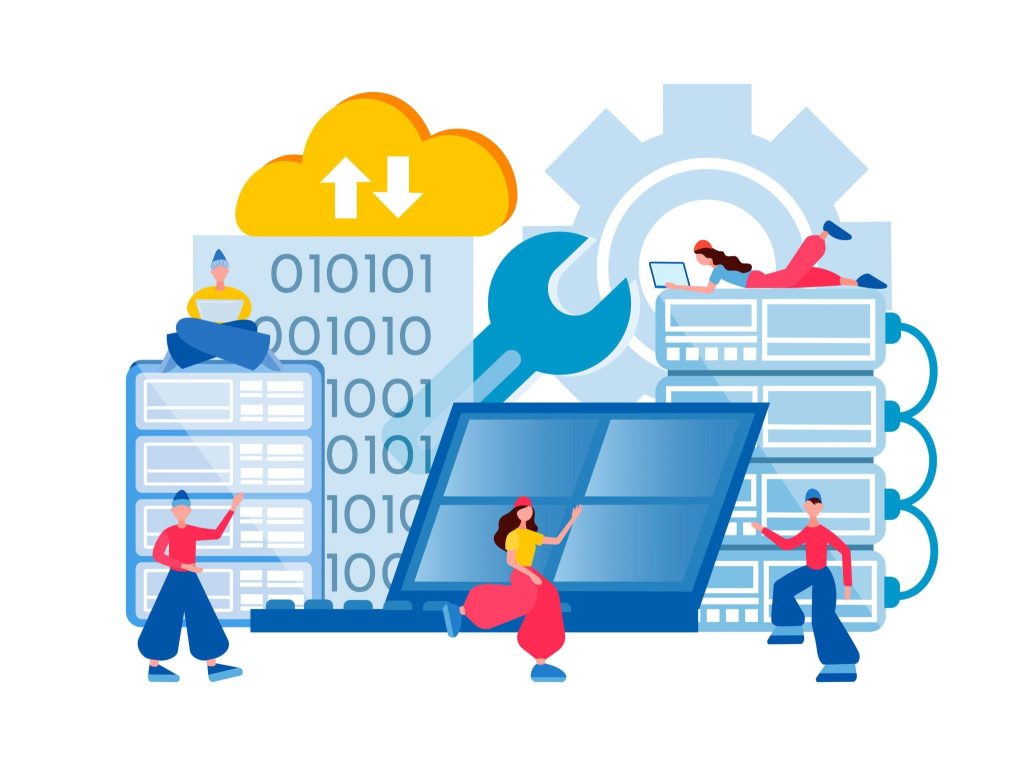
This is the part nobody really talks about, but it is probably the most important. Getting this wrong is expensive — both in terms of money and lost time.
Here are the things I would genuinely look for:
1. Do they have a proven track record? Look at their portfolio. Real projects, real clients, real problems solved. Not just pretty screenshots — actual case studies with results. Quytech, for instance, has built things like AI-powered patent research software (reduced research time from months to days), car damage detection systems using computer vision, and HRMS products with facial recognition — all for real clients across industries.
2. Do they follow a structured development process? The best companies follow an agile, iterative approach: requirement analysis → UI/UX design → development sprints → rigorous QA testing → deployment → ongoing maintenance. If a company cannot clearly explain their process, that is a red flag.
3. What is their QA and security approach? Good software is tested multiple times before it ever reaches users. Functional testing, performance testing, security testing — all of it. Cutting corners here is how companies end up with buggy, vulnerable software.
4. Are they compliant with industry regulations? Depending on your industry, your software may need to follow GDPR, HIPAA, PCI-DSS, or CCPA standards. Not all development companies think about this proactively. The ones that do save you a lot of headache later.
5. What engagement model do they offer? Three main options: dedicated team (they work exclusively on your project), staff augmentation (they fill skill gaps in your existing team), or full outsourcing (they handle everything while you focus on your business). A flexible company will offer all three.
Industries That Are Going All-In on Custom Software
Almost every industry is investing here, but a few stand out:
Healthcare: HIPAA-compliant patient management, telemedicine platforms, EHR systems. The pressure to digitise healthcare is massive — both in India and globally.
Fintech: AI-driven risk assessment, mobile banking, fraud detection systems. Security and compliance are critical here.
Retail and E-Commerce: Custom shopping platforms, inventory systems, personalisation engines. Offline-to-online is the journey every retailer is on.
EdTech: LMS platforms, virtual classrooms, adaptive learning systems. Post-COVID, this sector has genuinely not slowed down.
Logistics: Route optimisation, real-time tracking, warehouse management. The supply chain chaos of recent years has pushed every logistics company to invest in smarter software.
Quick Checklist Before You Hire a Software Development Company
Before you sign anything, run through this list:
- Have you seen their portfolio — specifically case studies, not just logos?
- Do they have developers with domain expertise in your industry?
- Is their development process agile and transparent?
- Do they have a 3-tier QA process or equivalent?
- Do they handle compliance requirements (GDPR, HIPAA, etc.)?
- Do they offer post-launch maintenance and support?
- Are their engagement models flexible (dedicated team / augmentation / full outsourcing)?
- Do they sign an NDA and follow strong IP protection practices?
- Do they have real client reviews on platforms like Clutch or GoodFirms?
- Do they have experience with modern tech — AI, cloud, mobile, blockchain?
Final Thoughts: Software Is Not a Cost — It Is a Competitive Advantage
There is this tendency, especially among businesses that are not “tech companies,” to treat software development as a necessary expense. Like paying rent or electricity. Something you minimise.
That thinking is becoming more dangerous by the year.
In 2026, your software is your product. It is the interface through which your customers experience your brand. It is the system through which your team operates. It is the engine that generates (or destroys) efficiency at every level of your organisation.
Getting your software development services right — choosing the right partner, with the right process, and the right technology — is one of the highest-leverage decisions any business can make today.
Whether you are a bootstrapped founder or running a 500-person enterprise, the question is not “should we invest in custom software?” It is “how quickly can we get it right?”
And the answer starts with finding a partner who actually gives a damn about your outcome — not just the code they deliver.
Looking for custom software development services built around your actual business goals? Quytech has a team of 500+ pre-vetted developers with 16+ years of experience delivering 700+ software solutions across industries. Check out their work at quytech.com/software-development-services.php.


